





Artist
Eva Marisaldi
Shampoo 2
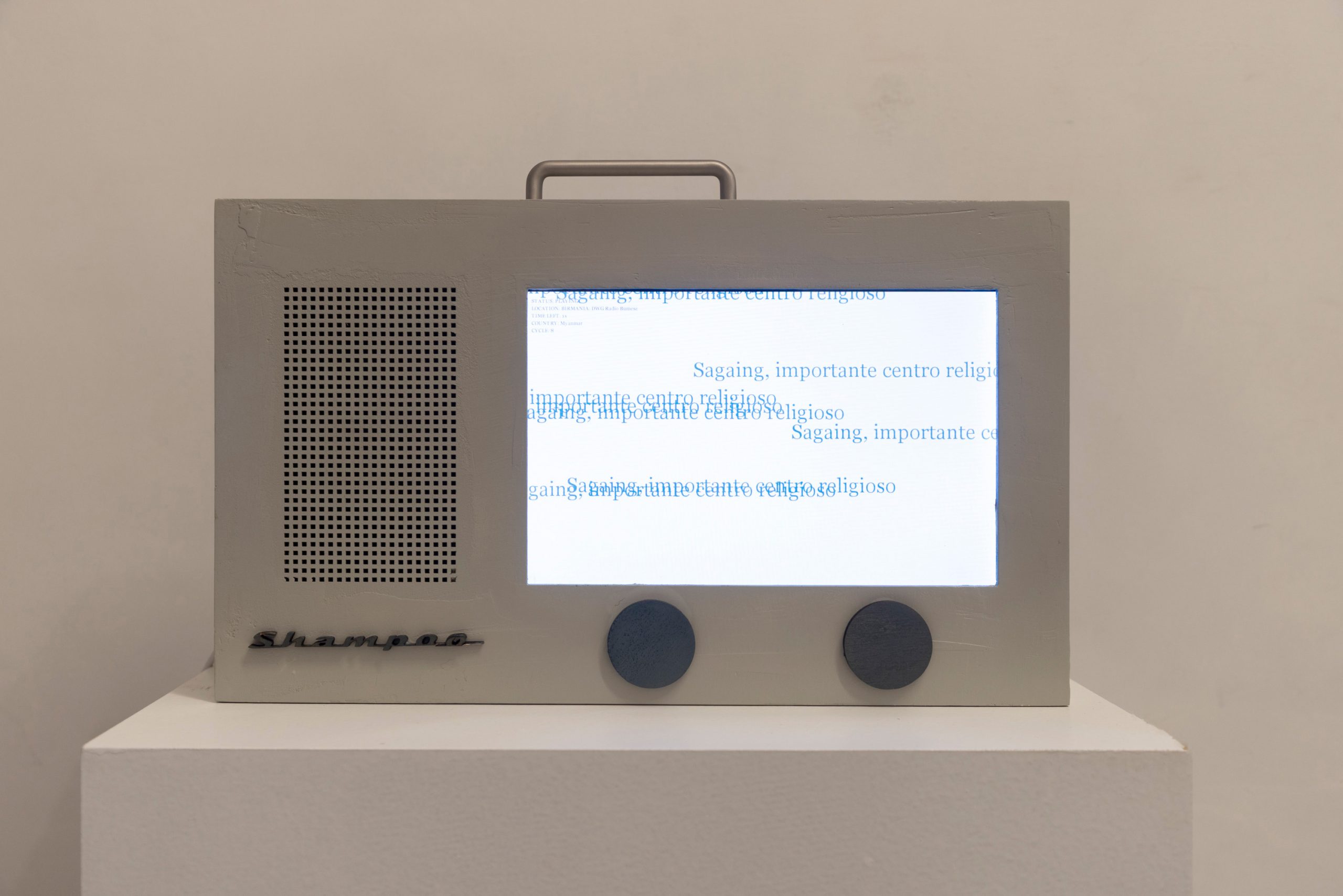
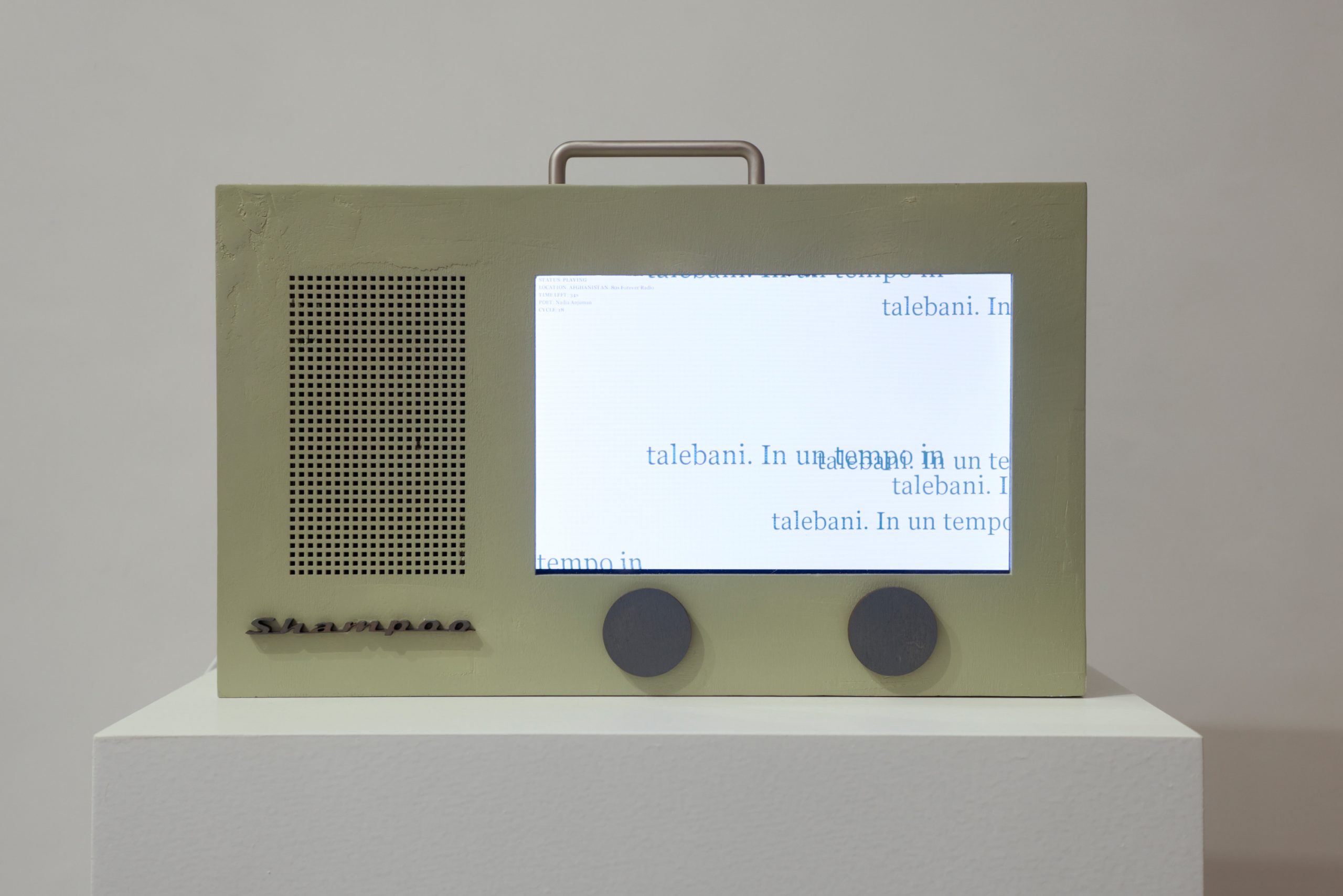
Audiovisual information system, wood, computer, software, 2025. Courtesy of the artist and Galleria De’ Foscherari, Bologna
back to the exhibition

The two multimedia sculptures by Eva Marisaldi, Shampoo 1 and Shampoo 2, are conceived as devices of passage and media drift. Through randomly selected radio broadcasts originating from the Eurasian space, the works invite the viewer on an immaterial journey across continents, transcending geographical and cultural borders. On the screen, appear fragments of text about the broadcasting country: in the first work, poetic and lyrical tones emerge, while in the second, references of a geopolitical and economic nature come to the fore. Drawing on the Dadaist practice of cut-up, an integrated artificial intelligence system selects and recomposes radio and textual content, generating a polyphonic and unpredictable fabric of languages, music, and narratives. It is in the tension between fragmentation and cosmopolitanism that the complexity of today’s world becomes apparent. Like a contemporary flâneur, the viewer is guided through fluid and stratified intercontinental identities in constant transformation. The continuous flow that traverses the works dissolves any notion of fixed national belonging, instead suggesting a dynamic, transient, and open conception of identity and affiliation.
Eva Marisaldi (Bologna, 1966) lives and works in Bologna. Through drawing, photography, sculpture, video, and performance, Marisaldi develops an anthropological reading of what lies beneath conventions, focusing on modes of communication and language, as well as the rules that shape human behavior. In 1998, she began a long-term collaboration with musician Enrico Serotti. Her work has been presented in numerous international exhibitions, including the Venice Biennale (1993, 2001), the Istanbul Biennial (1999), Sonsbeek 9 (Arnhem,
2001), Happiness, Mori Art Museum (2002), the Lyon Biennale (2003), the Alexandria Biennale (2003), the Sevilla Biennial (2004), the Gwangju Biennale (2004), the Quadriennale di Roma (2005), two special projects for Art Basel (Basel 2001, Miami 2007), No Soul for Sale at Tate Modern (2011), Documenta (2012), Think Twice at Whitechapel Gallery (London, 2012), Do it (Prishtina, 2014), and the Havana Biennial (2024).
Shampoo 1
Audiovisual information system, wood, computer, software, 2025. Courtesy of the artist and Galleria De’ Foscherari, Bologna
Shampoo 2
Audiovisual information system, wood, computer, software, 2025. Courtesy of the artist and Galleria De’ Foscherari, Bologna
back to the exhibition


- Fondazione Imago Mundi ETS
- Piazza del Duomo, 20
- 31100 Treviso, Italy
- Tax Code 94161540268
- info@fondazioneimagomundi.org
- +39 0422 512200
- © 2026 Fondazione Imago Mundi ETS
- Legal Terms / Privacy & Cookie Policy / Credit
- Follow us:
-


-



- Fondazione Imago Mundi ETS
- Piazza del Duomo, 20
- 31100 Treviso, Italy
- Tax Code 94161540268
- info@fondazioneimagomundi.org
- +39 0422 512200
- © 2026 Fondazione Imago Mundi ETS
- Legal Terms / Privacy & Cookie Policy / Credit
- Follow us:
-
-
- Fondazione Imago Mundi ETS
- Piazza del Duomo, 20
- 31100 Treviso, Italy
- Tax Code 94161540268
Follow us:


