





Artist
Mario Ceroli
back to the exhibition

Mario Ceroli is regarded as a pivotal figure in postwar Italian art and a precursor of Arte Povera, thanks to his innovative use of unconventional materials. His sculptures from the 1960s are particularly renowned for their forms inspired by Pop language and for their personal reinterpretation of great masterpieces from art history. The artist creates serial silhouettes cut from simple Russian pinewood boards, left raw and unpainted, which are transformed into monumental sculptural groups. Through these installations, he occupies and reshapes exhibition spaces, creating immersive and highly evocative environments. Over time, his artistic research expanded to include reclaimed materials such as burnt wood, lead, rags, ice, paper, ash, and sheet metal, eventually incorporating gold leaf in his more recent works.
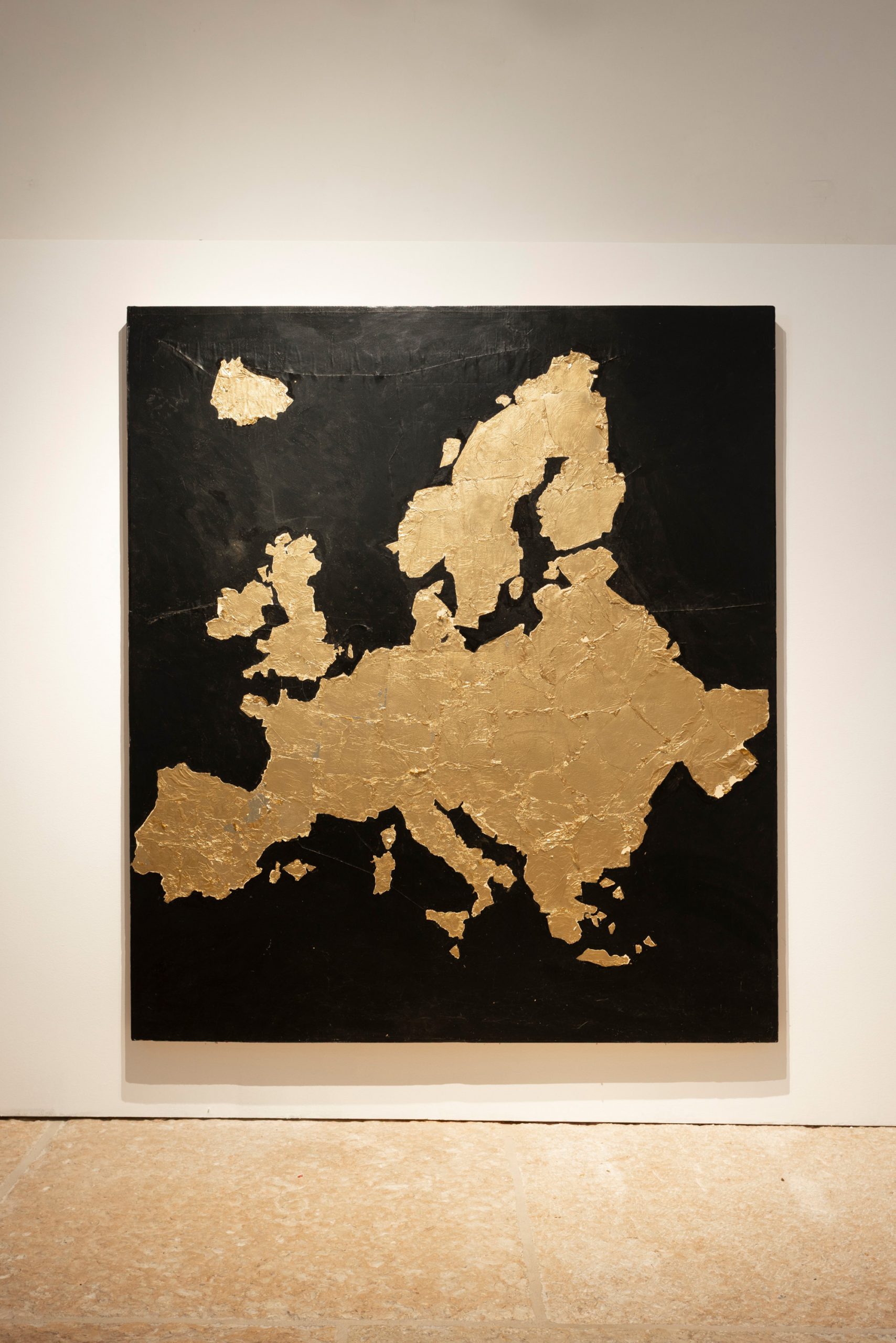
In Senza titolo (Untitled), the outline of political Europe emerges from a wooden panel, traced through the use of gold leaf. The material immediately recalls the golden stars of the European flag and the sense of hope and unity they continue to symbolize. At the same time, however, the preciousness of gold introduces a more ambiguous and critical reflection: beneath the apparent splendor and opulence of the surface lie questions about the contradictions and fragilities of contemporary Europe.
Mario Ceroli (Chieti, 1938) lives and works in Rome. In the 1950s, he attended the Art Institute of Rome and began working in the studios of artists such as Leoncillo Leonardi, Ettore Colla, and Pericle Fazzini. In 1956, he chose wood as his primary material, a decisive turning point that would profoundly shape his artistic practice.
In 1964, he held his first exhibition at Galleria La Tartaruga in Rome, which hosted two further solo exhibitions over the following two years. In 1966, he won the Premio Gollin at the 33rd Venice Biennale with the work Cassa Sistina. During the following two years, he lived in New York and exhibited at the Bonino Gallery. Upon returning to Italy, he participated with the Arte Povera group in the exhibitions Fuoco, immagine, acqua, terra at L’Attico in Rome and Arte povera – Im-Spazio in Genoa, both in 1967. He also took part in the landmark exhibition Vitalità del negativo nell’arte italiana 1960/70 (1970) at the Palazzo delle Esposizioni, as well as in six editions of the Venice Biennale and four editions of the Rome Quadriennale.
Senza titolo
Painted wood, gold leaf, 2010. Courtesy 21Art
back to the exhibition


- Fondazione Imago Mundi ETS
- Piazza del Duomo, 20
- 31100 Treviso, Italy
- Tax Code 94161540268
- info@fondazioneimagomundi.org
- +39 0422 512200
- © 2026 Fondazione Imago Mundi ETS
- Legal Terms / Privacy & Cookie Policy / Credit
- Follow us:
-


-



- Fondazione Imago Mundi ETS
- Piazza del Duomo, 20
- 31100 Treviso, Italy
- Tax Code 94161540268
- info@fondazioneimagomundi.org
- +39 0422 512200
- © 2026 Fondazione Imago Mundi ETS
- Legal Terms / Privacy & Cookie Policy / Credit
- Follow us:
-
-
- Fondazione Imago Mundi ETS
- Piazza del Duomo, 20
- 31100 Treviso, Italy
- Tax Code 94161540268
Follow us:


