





Artist
Matteo Attruia
back to the exhibition

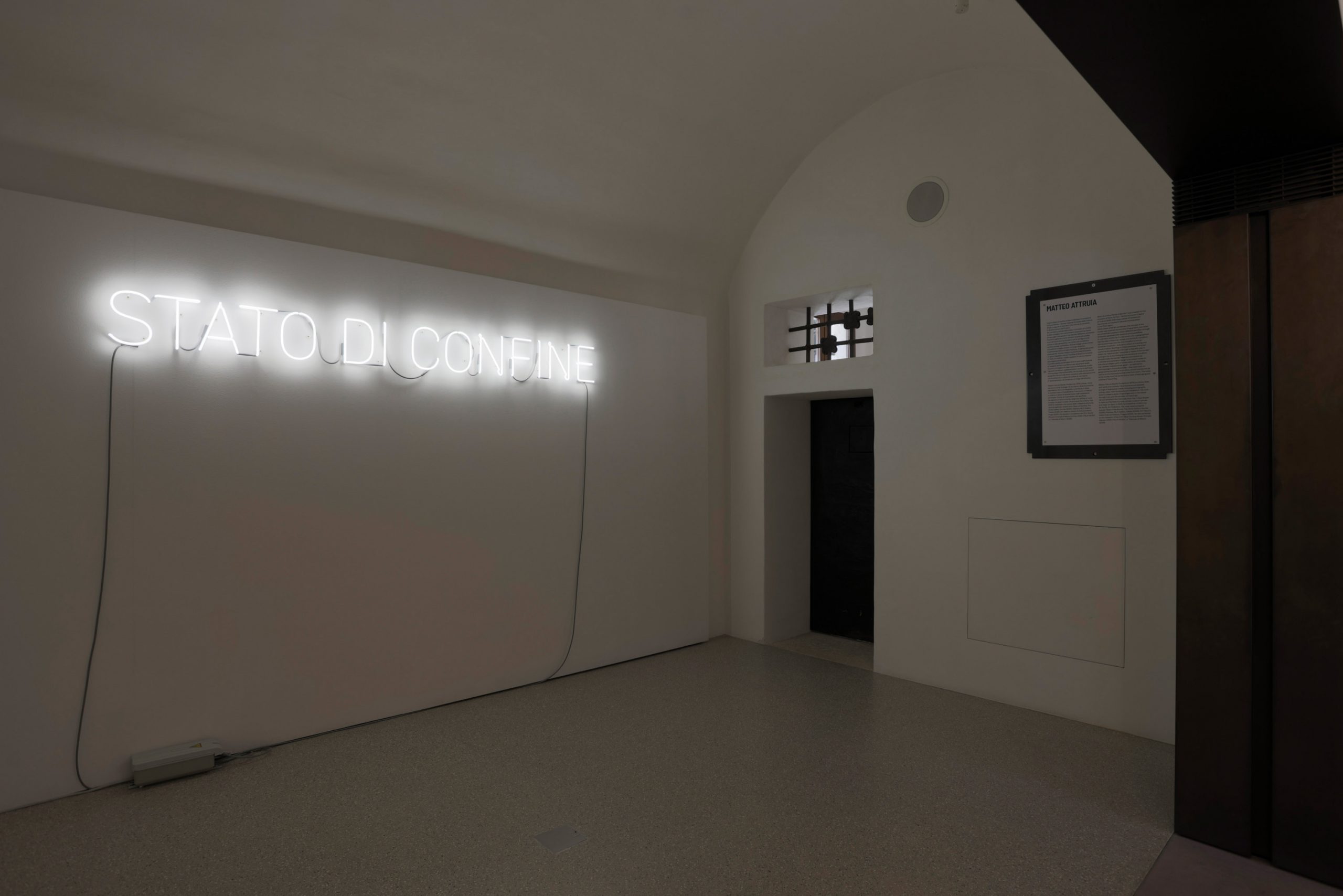
Stato di confine (‘State of Border’) was created on the occasion of Nova Gorica – Gorizia European Capital of Culture 2025, following a series of workshops that Attruia conducted in several municipalities in the Friuli region. Within these artist-led workshops, the concept of the border was explored not as a line of separation, but rather as a threshold: a space in which different identities, through encounter, generate both tensions and possibilities. In a territory where the frontier is not only a geographical fact but also a historical, social, and symbolic condition, Attruia examines how the limit transforms into an inhabited threshold – a dynamic place of crossing and transformation. Building on these premises, the artist overturns the perspective through a linguistic play in which the “state border” becomes a “state of the border,” turning it into a psychological and emotional condition. Paradoxically, the border loses its connotation as a remote and peripheral margin and instead takes on that of a privileged point of observation of otherness, that ‘skewed, kaleidoscopic gaze’ – as defined by anthropologist Chiara Brambilla – that rests both on geographical borders and on ethno-social boundaries, as well as on the interactions that arise from them. The state of the border is at the same time a mark of belonging and a space of becoming.
Matteo Attruia (Sacile, Pordenone, 1973), he thinks, lives, and works everywhere. His practice encompasses a range of expressive media, including photography, writing, video, neon sculpture, and installation. His work aims to create a sense of estrangement in the viewer through irony and the paradox of meanings. He has exhibited internationally, from the United States to Asia and Northern Europe, across museum venues and major art fairs. In 2018, he created an artist’s cup for the Illy Art Collection. His most recent projects include: State of the Border, The Circle Gallery, Gorizia (2026); INattesa, MLZ Gallery, Trieste (2025); All I Need Is, Italian Cultural Institute, Prague (2024). He also exhibited on the occasion of the XXV Milan Cortina Winter Olympic Games, CASA ITALIA MUSA, La Triennale di Milano (2026).
One by One
2021, performance, video 4K, 53’36”, color, sound. Courtesy of the artist and Prometeo Gallery
back to the exhibition


- Fondazione Imago Mundi ETS
- Piazza del Duomo, 20
- 31100 Treviso, Italy
- Tax Code 94161540268
- info@fondazioneimagomundi.org
- +39 0422 512200
- © 2026 Fondazione Imago Mundi ETS
- Legal Terms / Privacy & Cookie Policy / Credit
- Follow us:
-


-



- Fondazione Imago Mundi ETS
- Piazza del Duomo, 20
- 31100 Treviso, Italy
- Tax Code 94161540268
- info@fondazioneimagomundi.org
- +39 0422 512200
- © 2026 Fondazione Imago Mundi ETS
- Legal Terms / Privacy & Cookie Policy / Credit
- Follow us:
-
-
- Fondazione Imago Mundi ETS
- Piazza del Duomo, 20
- 31100 Treviso, Italy
- Tax Code 94161540268
Follow us:


