





Artist
Ryts Monet
back to the exhibition

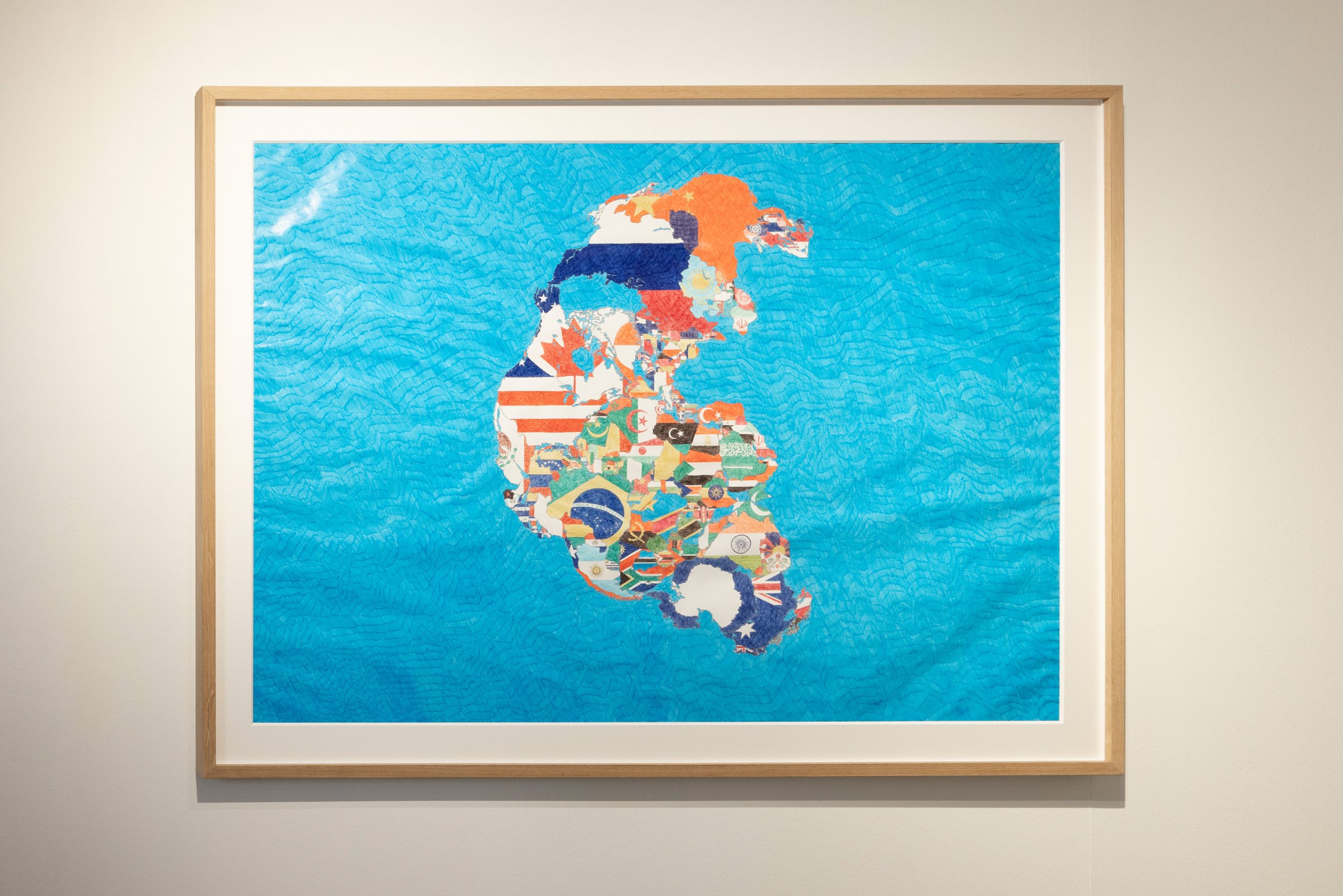
Pangea (In reference to Alighiero Boetti) takes the form of a hypothetical reconstruction in which the geopolitical plane collapses into the geological one.
The Earth’s surface as it appeared approximately 290 million years ago is reinterpreted by Ryts Monet through a division based on contemporary nation-states, redistributed across the Earth’s crust and represented by their respective flags, in an explicit homage to Alighiero Boetti and his renowned embroidered maps, to which the title refers.
However, the artist moves beyond the purely aesthetic dimension of the reference model: whereas Boetti entrusted the execution of his maps to Afghan embroiderers, in Pangea embroidery is both evoked and replaced by a meticulous graphic gesture, entirely drawn by hand using multicoloured ballpoint pens.
The result is a slow and rigorous process of execution, extending over nearly a year, which lends the surface of the work a simultaneously tactile and meditative quality. The temporal friction activated by the work – based on the layering of vastly distant chronological scales – highlights the intrinsic arbitrariness of political borders: territories now separated by vast oceans appear here once contiguous, while contemporary nation-states reveal themselves, in geological perspective, as transient entities dispersed across opposing hemispheres.
Ryts Monet, pseudonym of Enricomaria De Napoli (Bari, 1982), lives and works in Vienna. He studied at the IUAV University of Venice, where he received a BA in Visual Arts in 2007 and a specialization in Visual Communication in 2011. His interdisciplinary practice spans photography, installation, drawing, video, and performance, often incorporating pre-existing materials. His work has been exhibited internationally in public institutions and biennials, including BIENALSUR Buenos Aires (2023), the Quadriennale di Roma (2023), Steirischer Herbst (2020), the Nakanojo Biennale (2019), Kunsthaus Dresden (2019), Q21 MuseumsQuartier Vienna (2019), the Moscow International Biennale for Young Art (2018), Off Biennale Cairo (2018), Mediterranea 18 (2017), Kunsthaus Graz (2016), Fondazione Antonio Ratti (2016), Stedelijk Museum Bureau Amsterdam (2015), Tokyo Arts and Space (2013), and Kumu Art Museum (2011).
Pangea (In reference to Alighiero Boetti)
Colored ballpoint pens on paper, 2025. Courtesy of the artist
back to the exhibition


- Fondazione Imago Mundi ETS
- Piazza del Duomo, 20
- 31100 Treviso, Italy
- Tax Code 94161540268
- info@fondazioneimagomundi.org
- +39 0422 512200
- © 2026 Fondazione Imago Mundi ETS
- Legal Terms / Privacy & Cookie Policy / Credit
- Follow us:
-


-



- Fondazione Imago Mundi ETS
- Piazza del Duomo, 20
- 31100 Treviso, Italy
- Tax Code 94161540268
- info@fondazioneimagomundi.org
- +39 0422 512200
- © 2026 Fondazione Imago Mundi ETS
- Legal Terms / Privacy & Cookie Policy / Credit
- Follow us:
-
-
- Fondazione Imago Mundi ETS
- Piazza del Duomo, 20
- 31100 Treviso, Italy
- Tax Code 94161540268
Follow us:


