


Dora García
October 2026
Artist, teacher and researcher, Dora García creates performances, films and installations interweaving literature, psychoanalysis and political movements.
In her work, García constructs a conceptual and metaphorical framework that explores the boundaries between norm and deviance, the potential of marginality, fiction in art, and the symbolic logics that shape our relationship with culture. Blurring the boundaries between fiction and reality, García involves audiences to such an extent that they create, activate or even destroy the work itself. We met her on the occasion of her latest performance presented at the last edition of ArtVerona, Cittadini! to discuss participation, community, and how to build a different future.
Cittadini! (Citizens!) is a participatory performance presented as part of Secondo Tempo | Palazzo Forti at the latest edition of ArtVerona. Emerging from your research into Verona’s historical and social context, the work was developed in collaboration with local associations and students from the Academy of Fine Arts. It explores citizenship as a social and political contract between the individual and the State, one that enables people to participate in public life and shape the society they live in. Today, however, citizenship seems to be determined more by the circumstances of one’s birth than by shared values or a sense of belonging to a common space. What does being a citizen mean to you?
As is emphasized several times throughout the performance, citizenship means the right to have rights. Citizenship means belonging to a political community, having a say in it, and participating in the political debate. I am outraged by concepts currently being advanced in political debate, such as “remigration” or—even more ridiculously— “reconquista.” They are based on a fallacy, namely the assumption that some people are superior to others—based on the fiction of race, based on the fiction of belonging more than others. These days, it seems dangerously revolutionary to state what most democratic constitutions affirm: that every human being has rights that must be respected. These are the terrible times in which we live, when bigotry and racism dominate the political debate.
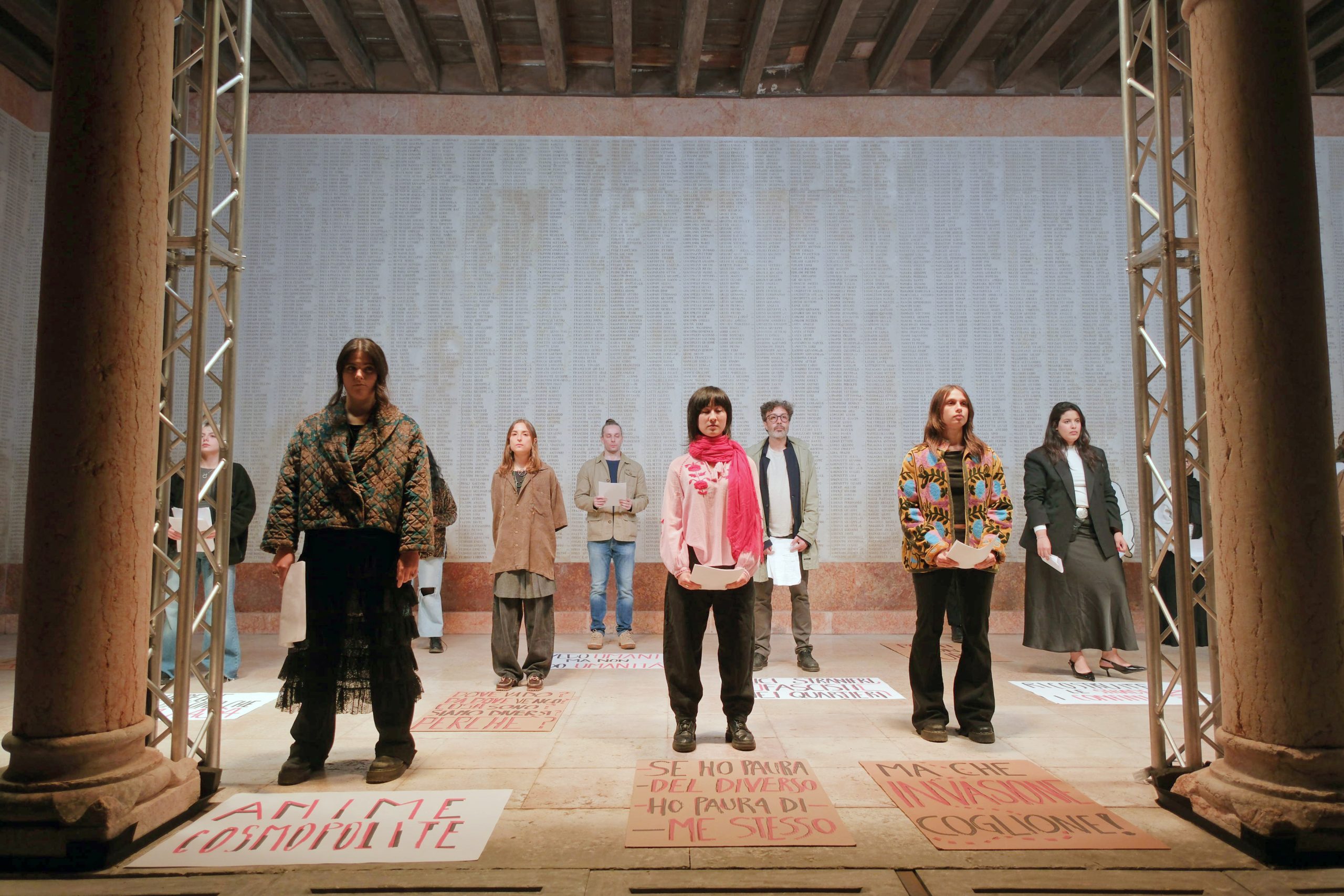
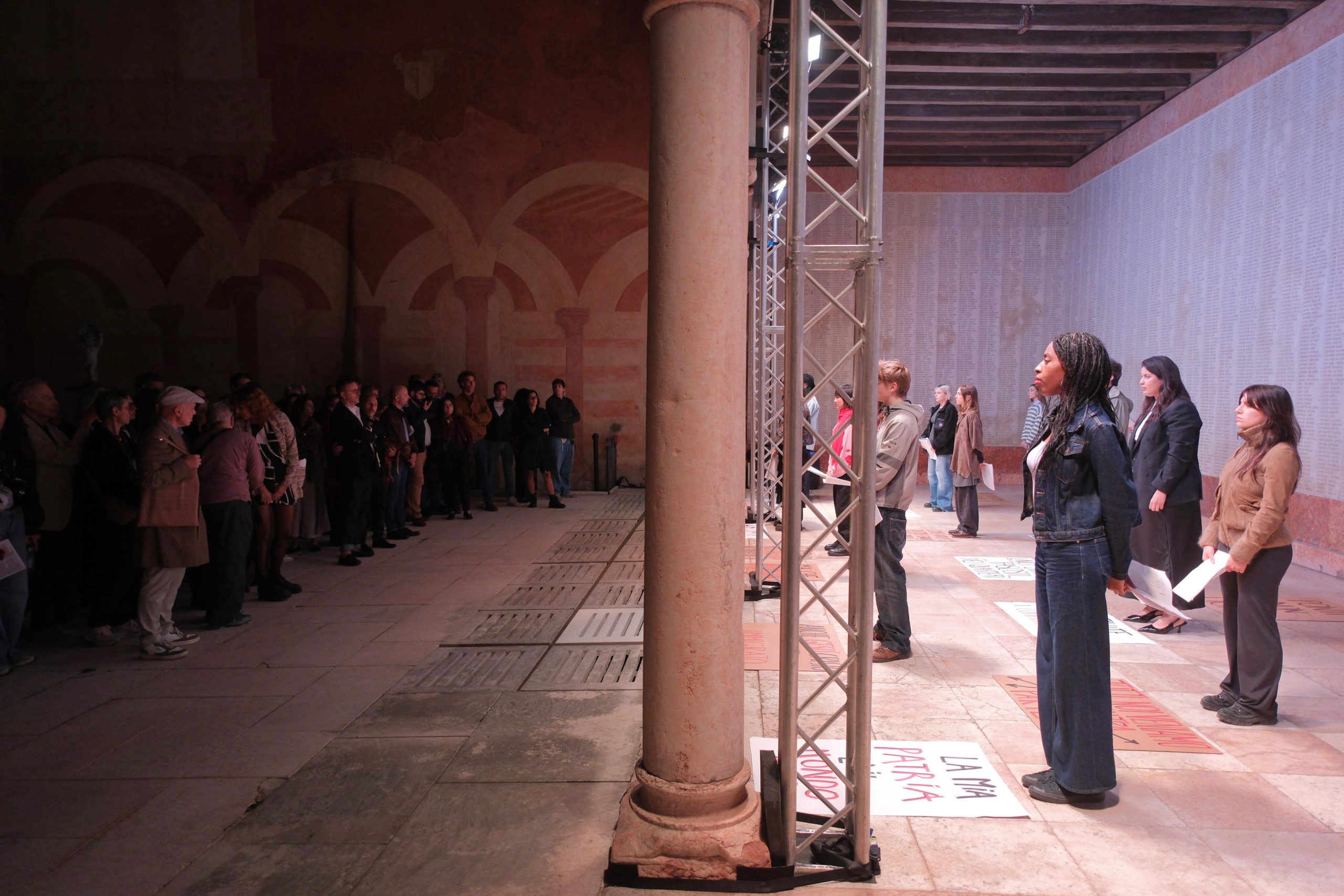
In an interview with Joanna Zielińska, you described your practice as belonging to the visual arts, arguing that artistic disciplines are defined not by their material forms but by the circuits through which they circulate. Cittadini! took place in the Famedio of Palazzo Forti, a portico in the museum courtyard whose walls bear the names of Veronese soldiers who died in the colonial wars and the two World Wars. How did this specific setting inform the work? Would the performance have taken on a different meaning had it taken place outside the museum context?
The performance could have taken place in any public venue, but the “Famedio,” with Verona’s beloved fallen—the list of names, so to speak, of those citizens of Verona who gave their lives for their country—one cannot love a country more than that (even though I sincerely believe it would have been better if these young men had returned alive and well to their families and had not had to die for the interests of an economic and political elite) —this “Famedio” lends the performance a very valuable dimension, an additional layer of meaning, by making it clear that heroism is not only the legacy of fallen soldiers, but also that of migrant communities.
Art, particularly contemporary art, rarely offers answers or solutions. More often, it raises questions and opens up space for reflection. I’ve read that you always learn something from your performances, partly because you often begin by knowing less about the subject than the people involved. What did you learn from Cittadini!? What has the experience left you with?
Cittadini! was a performance that came together in just a few months, during which I was fortunate to have the enthusiastic support of the performers, my friend and collaborator Marlene Fantoni, and the curatorial team, who made the impossible possible. Even in this short time, I was able to recognize and reflect on the dangerous situation in which Italy and Europe currently find themselves—at a time when the trend is toward isolation, away from the idea of a democratic, pluralistic Europe, toward racism and fascism, toward fear of the foreign, toward exclusion, and toward the denial of rights and refuge for those fleeing oppression and war.
You have suggested, inverting our usual understanding of cause and effect, that the future shapes the present: if we envision a particular future, we must act in the present to bring it about. Your work has often focused on subjects that might be considered “minor”: the marginalised, the oppressed, the inadequate, the repressed and the overlooked. It seems to trace alternative, parallel or abandoned paths, bringing attention to what has been pushed aside. Does this focus on the margins stem from a desire to imagine and build a different future—one that begins with what the present has excluded?
I love this idea, put forward by psychoanalysts, that love requires the ability to imagine a future. If we cannot imagine a future, we cannot love. This projection into the future is what makes optimism and joy possible; we could paraphrase Gramsci once again: “pessimism of the intellect, optimism of the will.” That is why, in a time like the one I described earlier, it is very important not to give up on joy, to be able to continue imagining a future in which democracy exists, in which everyone is part of the community, in which everyone is valued, accepted, and loved, regardless of their background, how marginalized they are, how much they’ve been left behind, their appearance, or, of course, whom they love. This—which may seem “radical” or “naive” to some, or even that horrible word, “woke”—is nothing more and nothing less than what the Gospel says. So yes, we must imagine a future worth living, because only then can we live in the present. And this future is for all of us: we will only survive if we all survive.
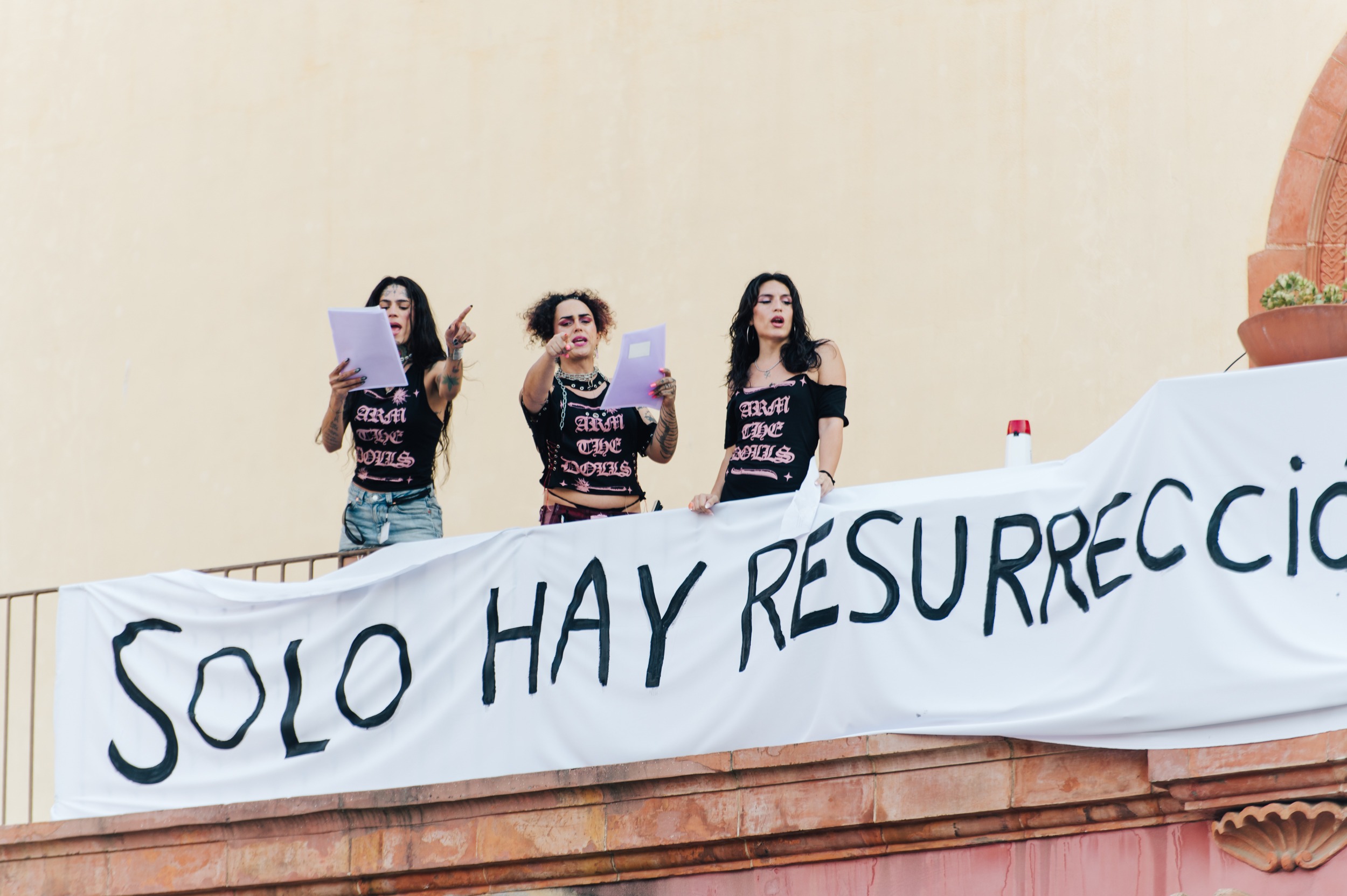
PHOTO CREDITS
Performance photos, Cittadini!, 2026, Famedio Palazzo Forti, Verona. Ph. credit Ennevi Foto
Performance photo, Corocuerpo, 2026, Museu Tàpies, Barcelona.
BIO
Dora García is an artist, teacher, and researcher who lives and works in Barcelona and Oslo. As an artist, she has participated in numerous international art exhibitions, including Münster Skulptur Projekte (2007), the Venice Biennale (2011, 2013, 2015), the Sydney Biennale (2008), the São Paulo Biennial (2010), Documenta 13 (2012), the Gwangju Biennale (2016), osloBiennalen, Art Encounters Timisoara, and the Aichi Triennale (2019). In 2021, he developed projects at Fotogalleriet Oslo, Netwerk Aalst, as well as at the Mattatoio in Rome and for the Colomboskope festival in Sri Lanka. His work is largely performative and addresses issues related to community and individuality in contemporary society, exploring the political potential of marginalized positions and paying homage to eccentric figures and anti-heroes, who have often been at the center of his film projects, such as The Deviant Majority (2010), The Joycean Society (2013), and Segunda Vez (2018).


- Fondazione Imago Mundi ETS
- Piazza del Duomo, 20
- 31100 Treviso, Italy
- Tax Code 94161540268
- info@fondazioneimagomundi.org
- +39 0422 512200
- © 2026 Fondazione Imago Mundi ETS
- Legal Terms / Privacy & Cookie Policy / Credit
- Follow us:
-


-


- Fondazione Imago Mundi ETS
- Piazza del Duomo, 20
- 31100 Treviso, Italy
- Tax Code 94161540268
- info@fondazioneimagomundi.org
- +39 0422 512200
- © 2026 Fondazione Imago Mundi ETS
- Legal Terms / Privacy & Cookie Policy / Credit
- Follow us:
-
-
- Fondazione Imago Mundi ETS
- Piazza del Duomo, 20
- 31100 Treviso, Italy
- Tax Code 94161540268
Follow us:


